
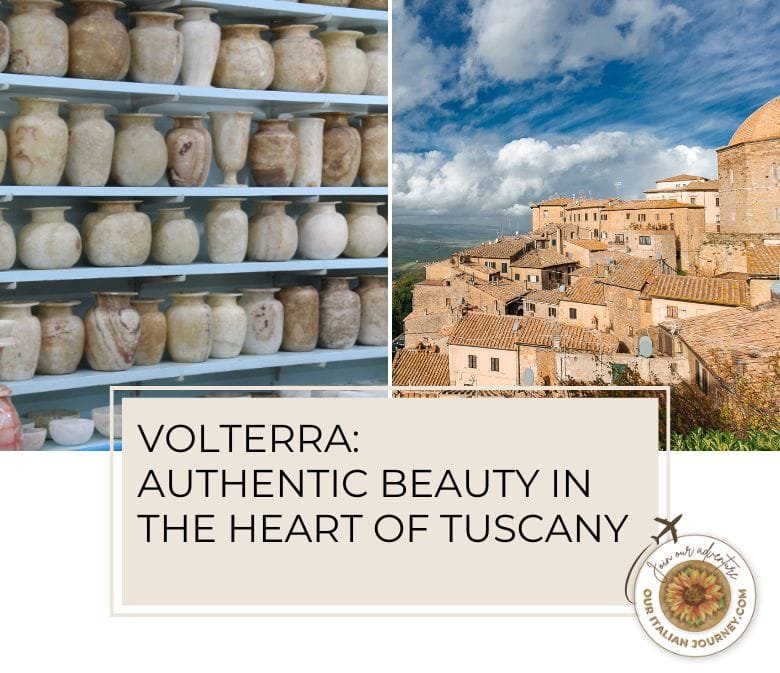
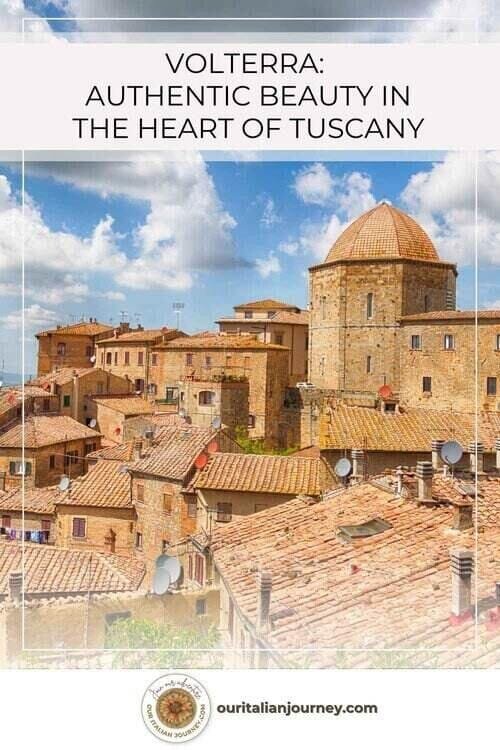
Volterra is one of those Tuscan towns that stays with you long after you leave. High on a rocky hill and wrapped in centuries of history, it feels quieter and more lived-in than many places in Tuscany. This is a town shaped by stone, by craft, and by time. If you love places with strong character, fewer crowds, and stories layered into every street, Volterra belongs on your itinerary.
This town is one of my favorites in Italy, and I was dumbfounded that I had not already written a post about it. How in the world did this happen?… I’m genuinely not sure.
This post contains affiliate links that help keep this website running. By purchasing through our links, we make a small commission at no extra charge to you. Thank you for your support!
Let’s Begin…
When arriving in Volterra, it’s one of those towns that feels powerful the moment you arrive. Sitting between Florence, Siena, and the coast, it has an ancient, almost mysterious feel. Perhaps fewer souvenir shops. More history. And a deep connection to alabaster that still defines the town today.
Where Volterra Is and Why It Feels Different in Tuscany
Unlike many Tuscan towns built around Renaissance elegance, Volterra feels older and rugged in the best way. That’s because it is. The town was an important Etruscan center long before the Romans arrived, and you can still feel that layered history as you walk its stone streets.
The pace here is slower. Tour buses come and go, but Volterra never feels overwhelmed. It’s the kind of place where locals linger in piazzas and shops close for lunch without apology.
A Brief History of Volterra
Volterra is considered one of the oldest cities in Italy, with roots that reach before the founding of Rome. Known to the Etruscans as Velathri, it was already a vital and thriving settlement by at least the 8th century BC.
Volterra’s story starts with the Etruscans, who settled here more than 2,500 years ago. The town later became a Roman municipium, and you can still see a remarkably well-preserved Roman theater just outside the medieval walls.
During the Middle Ages, Volterra grew wealthy from trade and craftsmanship. Its defensive walls, towers, and fortress-like buildings weren’t built for beauty. They were built for survival. Today, that strength is part of its charm.
Volterra’s Unique Alabaster
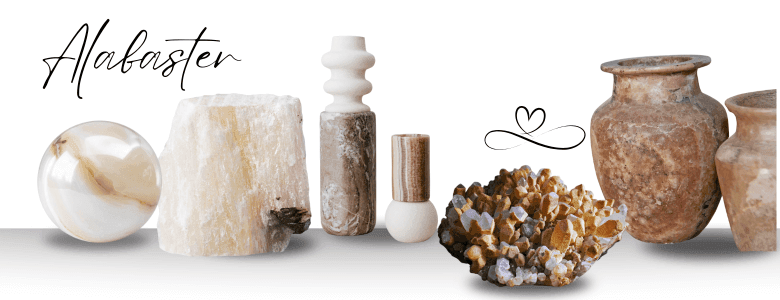
Alabaster is what truly sets Volterra apart. This soft, translucent stone has been quarried in the surrounding hills since Etruscan times. Unlike marble, alabaster is delicate and almost luminous when carved. It catches the light in a way that feels warm and alive.
Volterra became Italy’s center for alabaster craftsmanship, and it still holds that title today. Local artisans carve everything from small figurines and jewelry to lamps, vases, and intricate sculptures. This is not mass-produced work. Many workshops are family-run and have been passed down through generations.
One of the best ways to understand alabaster is to visit a working shop. Many stores allow you to watch artisans hand-carve the stone. You’ll see just how skilled and patient this work requires. The Museo dell’Alabastro Etrusco is also worth a visit if you want to see historic and modern pieces side by side.
Shopping for Alabaster in Volterra
If you plan to buy alabaster, Volterra is the place to do it. Look for shops that clearly state the pieces are made locally. Genuine Volterra alabaster is lighter than marble and often slightly translucent when held up to the light.
Avoid anything that feels too heavy or looks overly polished. Ask questions. Good shops are happy to explain their process and the stone’s origin.
What to See in Volterra Italy
- Start with Piazza dei Priori, one of Tuscany’s most beautiful medieval squares. The Palazzo dei Priori dominates the space and is the oldest town hall in Tuscany still in use.
- Walk the town walls for sweeping views of the countryside, then head to the Roman Theater, discovered in the 1950s and now one of Volterra’s most impressive sights.
- Don’t miss the Volterra Cathedral and Baptistery, both understated but rich in detail. Volterra isn’t flashy. It rewards visitors who slow down and look closely.
- Porta all’Arco is an Etruscan city gate built in the 4th century BC, and it still stands and is one of the best-preserved examples in Italy. Walking through it feels like stepping directly into ancient history.
- The Guarnacci Etruscan Museum is another highlight. It houses one of Italy’s most important collections of Etruscan artifacts, including funerary urns carved from alabaster. These pieces show just how long this stone has been tied to Volterra’s identity.

We wrote about Volterra in our second book, “When Your Heart Finds Its Home.” This is the Roman Theater. It dates to the end of the first-century B.C.
There is so much to see and explore in Volterra. Make sure you leave enough time to really take it all in.
Is Volterra Worth Visiting?
Absolutely. Volterra is perfect for travelers who want something more profound than the usual Tuscan highlights. It’s ideal for a day trip, but staying overnight lets you experience the town after the crowds have left, when it feels most like itself. Staying overnight was a highlight for Gary and me in 2012. It’s something we need to do again!
Volterra doesn’t try to impress you. It simply is what it is. Ancient. Creative. Beautiful. And most unforgettable. Volterra’s Etruscan roots are not just a footnote. They are everywhere once you know what to look for.
The Alabaster Quarries Around Volterra, Italy
The alabaster used in Volterra comes from deposits in the surrounding countryside, especially near the Cecina Valley. The stone forms naturally in underground cavities and is extracted in large, irregular chunks. Because alabaster is soft, it must be handled carefully from the moment it is removed from the earth.
Historically, quarrying alabaster was dangerous and challenging. Today, extraction is more controlled, but the material remains fragile. This is one reason authentic Volterra alabaster carries value. It is not easy to obtain, and it requires skill at every stage.
Volterra is one of our 31 towns in our Tuscany Treasures book!
How Alabaster Is Worked in Volterra
Once quarried, alabaster blocks are cut, dried, and slowly shaped. The stone must rest before carving to prevent cracking. Artisans then use hand tools to carve the form and then smooth and polish the surface.
Some pieces are left matte, while others are polished to allow light to pass through. Lamps made from alabaster are especially popular because they glow softly when lit, showing off the stone’s natural veins.
Volterra Beyond Alabaster
While alabaster is central to Volterra, there is much more to explore. The Medici Fortress dominates the skyline and reminds visitors of Florence’s control over the town. Although it is still used as a prison and cannot be fully visited, it adds to Volterra’s dramatic presence.
Volterra is also known for its food. Look for wild boar, local pecorino, truffles when in season, and simple pasta dishes rooted in the countryside. Meals here feel hearty and honest.
When to Visit Volterra
Spring and fall are the best times to visit Volterra. The weather is comfortable, and the countryside is at its most beautiful. Summer can be hot, but evenings cool down quickly thanks to the town’s elevation. If you visit in August, be aware that some artisan workshops may close for the holiday.
How to Get There
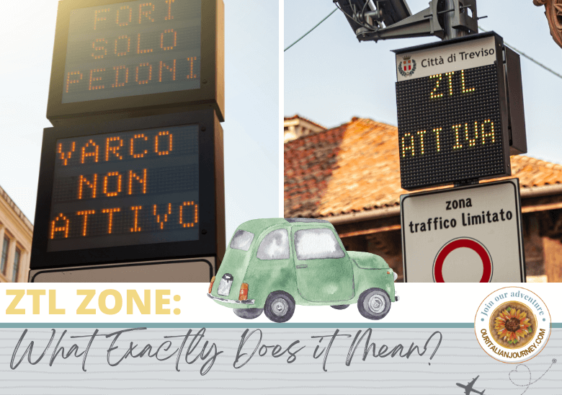
Volterra is easiest to reach by car. Roads wind through the hills, but the drive is scenic and worth it. Public transportation is possible, but it requires patience and multiple connections. Because of its location, Volterra makes a good stop between Florence, Siena, and the Tuscan coast.




Volterra is one of our favorite Tuscan towns… the first time we visited, we spent quite a bit of time in the Etruscan museum. We learned a lot but it was challenging. Most of the signs were in Italian and not very informative. A few years ago, they reorganized the museums and put in clear and informative signs, in both Italian and English. Now, excellent exhibits that are easier to understand!
Grazie Mille, JoAn, for your insight. Will be helpful to so many travelers. Thanks for commenting and contributing!
Volterra was on one of my planned itineraries during our last visit, but fell off when we decided upon a different route. It’s in our future for sure.
Well Tom, you and Carla just have to come back. We also say leave something to return to and you have! Your itinerary was quite aggressive so I’m not surprised somthing had to fall off. Perhaps we’ll visit together next time!