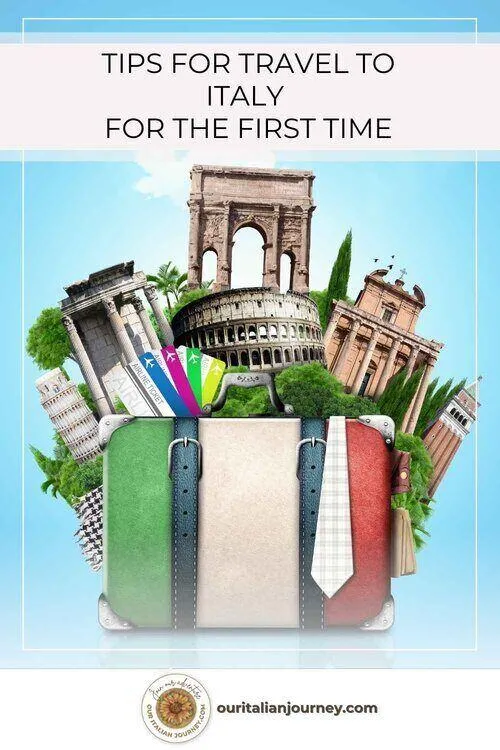
Here are our favorite tips for first-time travel to Italy. If you’ve never traveled to Italy before, this guide is meant to help you feel prepared, confident, and ready for the adventure. Italy is one of our favorite places in the world—which is why we worked toward citizenship—and we know that a bit of knowledge makes the experience so much smoother.
If you’re planning your first visit, take your time, read through these suggestions, and wander around our blog for city guides and day-trip ideas. You’ll be glad you did.
This post contains affiliate links that help keep this website running. By purchasing through our links, we make a small commission at no extra charge to you. Thank you for your support!
TRANSPORTATION
TRAINS
Trains
Italy runs on trains. They’re often the fastest and most stress-free way to move between cities. You’ll see a few main types:
- Regional (Regionale): Slower, cheaper, stops everywhere.
- Intercity: Faster than Regional with fewer stops.
- High-speed (Frecciarossa, Frecciargento, Italo): Quick, comfortable, and pricier—but they save valuable hours if your itinerary is tight.
Tickets can be purchased online or at the station. Online prices sometimes include discounts or early-purchase fares. At times, a Saturday might offer 2-for-1 high-speed ticket deals—but only if booked ahead.
Seat classes matter
First Class means an assigned seat with more comfort. Second Class is perfectly fine for most travelers—we use it often. If the train looks busy, buy a reservation to avoid standing.
Important: Validate Regionale tickets before boarding. Look for the small green or yellow machines on the platform. A non-validated ticket = a fine. This one is easy to forget, especially when you’re jet-lagged.

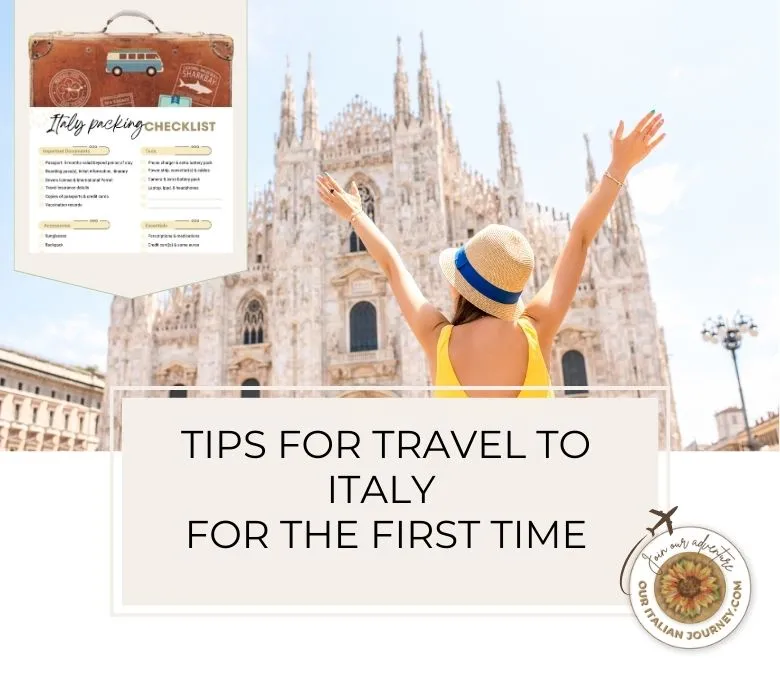
Use my Italy planners and notebooks above, and here’s a free packing checklist:
TAXIS
Taxis are handy but not cheap. Always look for official white taxis with a meter and a roof sign. The best way to get one is from a taxi stand or by calling ahead. Some people have no issues using an app- I don’t always have luck with these. Especially when headed to a train station to catch a particular train. But the available apps are worth having for those nonessential transportation trips.
Pro Tip: If you’re going a long distance, ask for the approximate cost first so you don’t get surprised when you arrive.
BUS
You can buy bus tickets at Tabacchi shops, stations, and ticket machines. Like train tickets, most require validation.
Some regions now allow contactless card payment onboard (Tuscany uses a TipTap system—one card per traveler). It’s convenient, but always check the system where you’re traveling as rules differ by region.

OTHER INFORMATION
BANKS
ATMs are called Bancomat. Credit/debit cards with a PIN work fine, but notify your bank before travel and ask about foreign fees. If you need to visit a bank in person, note the limited hours: generally morning to early afternoon, and closed weekends and holidays.
⚠️ Tip when withdrawing cash in Italy (or anywhere abroad): If your ATM asks whether you want to be charged in euros (local currency) or in dollars (or your home-country currency), always pick euros. Choosing your home currency triggers what’s called “dynamic currency conversion” (DCC), and that conversion rate is almost always worse than the market rate.
Letting your bank handle the conversion (by using euros) usually means you get a fair interbank-rate exchange, with only the usual foreign-transaction fee (if any) from your bank — instead of a steep, often undercover, markup from the ATM provider.
CREDIT CARDS
Visa and Mastercard are widely accepted. Discover is not. Some cards charge foreign transaction fees—always check before you leave. We use Charles Schwab for ATM withdrawals because they reimburse international fees. A perk we appreciate more than gelato on a summer day.
PHONES
Here is an important number to keep handy when traveling in Italy. 112 – Carabinieri (police)
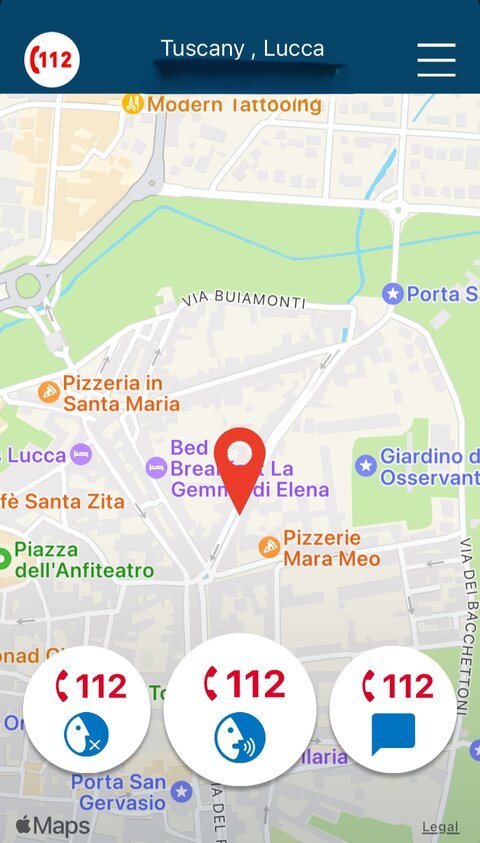
There is an app I highly recommend to use throughout Europe. It’s called: “112- Where Are U.” Once you download and open the app, you will notice three circles at the bottom as in our photo below. The first one with the “x” by the mouth indicates you call if you can’t speak Italian. The middle circle indicates you can speak Italian and the circle to the right is if you want to text. I haven’t had to use it yet, but we learned this at a CPR class in Lucca.
Other Areas…
When you land, you can stop by the airport to get an Italian SIM from TIM, Vodafone, or Iliad. Plans are inexpensive and great for data. WhatsApp is used everywhere in Italy—text, call, send photos, and even chat with restaurants. We use WhatsApp for calls and video calls back to the States. FaceTime works well iPhone-to-iPhone over Wi-Fi. To call the US: +1 + area code + number
Take a Trip to Italy!
Join others who have purchased and read our book – leaving heartwarming reviews!
Join our journey – we’d love to have you along for the ride!
POST OFFICE
Stamps (francobolli) are sold in Post Offices or at Tabacchi shops. Post offices usually operate mornings to early afternoons and close early on Saturdays.
RESTAURANTS
Menus and prices are displayed outside. When you sit down at a table, a coperto (service charge/cover fee) is common—especially in tourist zones. It’s normal and varies by region. Tipping isn’t expected. If the service felt special, leaving a few euros is enough. Dinner starts later than in the US—most restaurants open around 7:00–7:30 pm. If you’re hungry at 5 pm, look for a trattoria, bar, or a slice of pizza al taglio to hold you over.
RESTROOMS
Public restrooms aren’t always free. Train stations, tourist sites, and some cafes require coins, so keep small change handy. Restaurants generally expect you to be a paying customer to use the facilities—sometimes buying a quick espresso is the easiest way to do so. Here’s one of the most popular posts about Italian bathrooms.
We have tons of useful travel information on this site. Please use the “search” button to find more!

Editor’s Note: This post was initially published in March 2019 and was recently updated in September 2026 for accuracy and additional information.