
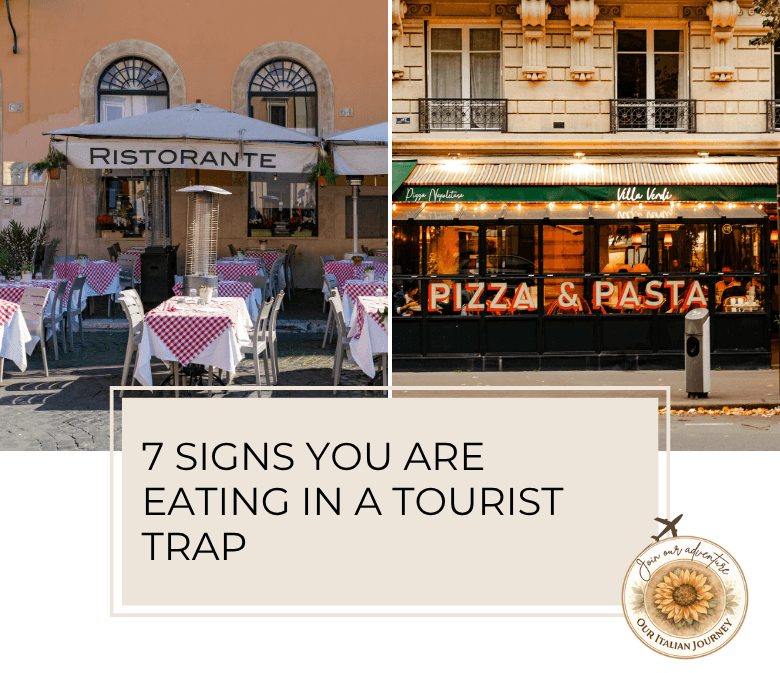
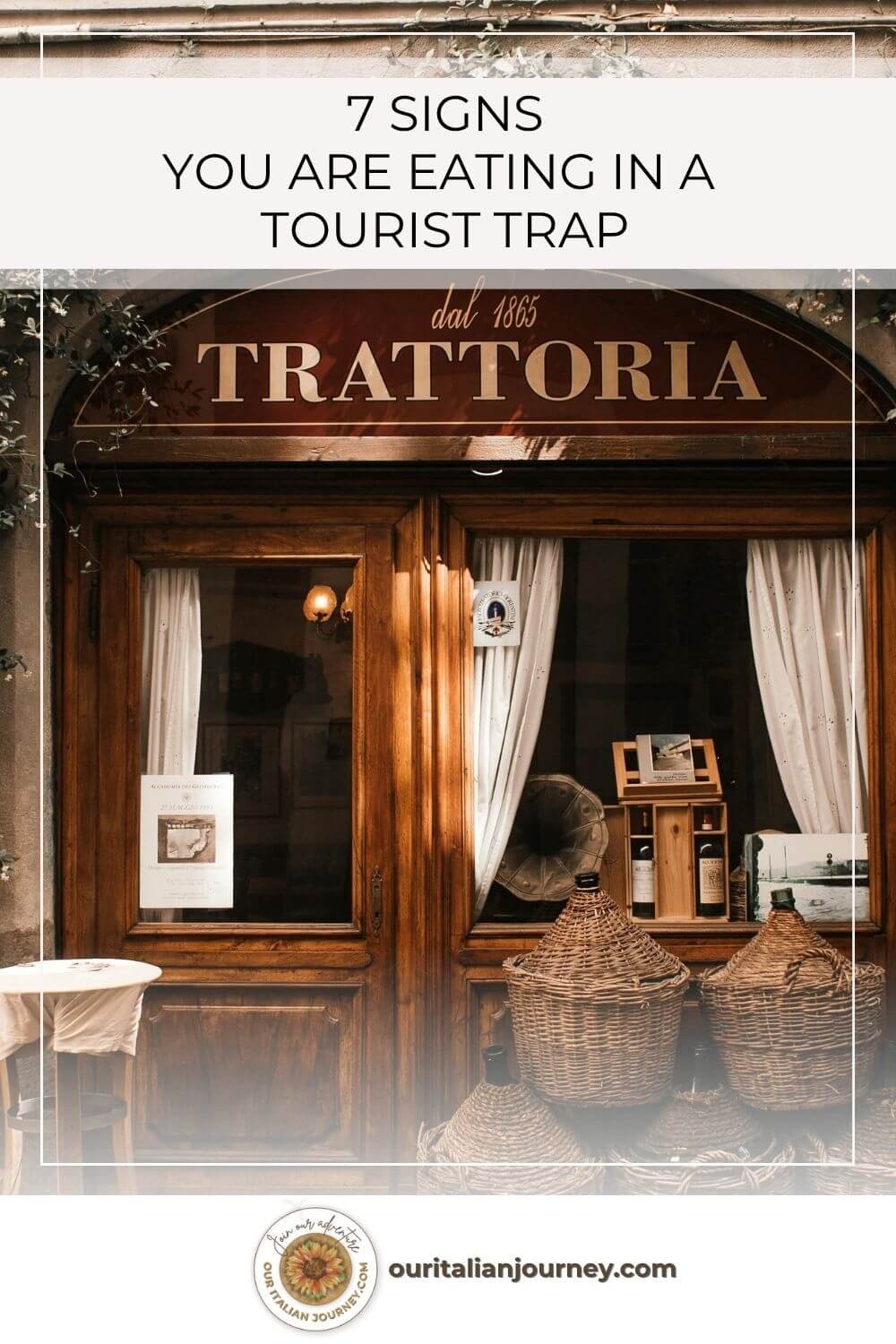
Signs of a tourist trap are everywhere in Italy — if you know what to look for. You finally get to Italy and want to truly enjoy the culture. You want to enjoy the people, the food, and La Dolce Vita, the good life. There are easy warning signs, especially in restaurants, that you can spot before ever sitting down at a table. We hope these 7 signs help you have a great experience.
This post contains affiliate links that help keep this website running. By purchasing through our links, we make a small commission at no extra charge to you. Thank you for your support!
What’s it All About
Italy is all about using seasonal ingredients. Most of the time, the neighborhood restaurants will all be offering the same seasonal items at about the same time. The dishes may vary, but the ingredients should all be about the same. Before you go, find out what is in season so you know what to look for. You will also be able to recognize these seasonal items by what is being offered at the little stands and grocery carts.
And here’s a bonus tip to tuck away: a long, pages-long menu is itself a red flag. Authentic Italian restaurants tend to offer a short, focused menu built around what’s fresh and seasonal — not a laminated novel with something for everyone.

Let’s Begin…
1. Look for the locals. If there are a bunch of people in the restaurant and no one is speaking Italian, move on. If staying at a hotel, ask the person at the desk where they go for lunch or dinner. Most of the time, this has worked for us. And here’s a fun, counterintuitive tip from travel expert Rick Steves: look for a TV inside. A television usually means the place caters to locals who come in regularly, not tourists passing through. Remember that Italians eat later than we are used to in the United States. Dinner doesn’t start until at least 7:30 pm, and any restaurant serving dinner at 5:00 or 6:00 pm is almost certainly catering to tourists. We found the best restaurant in Sorrento by walking down by the harbor. Our B&B suggested a place, but there were only a few people inside, so we continued our stroll and came to a small restaurant. We peeked in and listened to only Italian being spoken. The best dinner of our trip was at this restaurant.
2. If there are pictures of the food on the menu, it’s a good chance that tourists will eat there. Why would a good Italian restaurant need to show its customers what Spaghetti Carbonara looks like? Photo-heavy menus are often a red flag — they can signal that there’s no real kitchen on site and that the food may simply be reheated.
A Major One for Me
3. A variety of menus in different languages is a clear sign that the restaurant is catering to tourists rather than locals. If the menu appears in Italian, English, French, German, and Spanish, the main clientele is tourists. A neighborhood restaurant might offer a small English insert or a QR code translation, but it won’t be built around it. You can always use Google Translate on your phone to decipher an Italian-only menu — and that’s actually a great sign you’ve found somewhere worth eating.

7 Signs You are Eating in a Tourist Trap continues…..
4. Location, location, location. Close proximity to a major tourist attraction — say, the Colosseum or the Trevi Fountain — almost certainly means higher prices to cover expensive rent. Eating outside and gazing at a beautiful historic site is exactly what the owner is banking on. Most locals will not eat at a restaurant near one of these landmarks. Keep walking down the street a bit, and you will find something better suited to your taste buds and your wallet.
5. Be wary of employees standing outside asking you to come in. Any restaurant with a real reputation will never need to resort to having someone outside trying to smooth-talk you in. This is one of the most reliable red flags of all. That said, if you’re in a large piazza, such as in Verona or Siena, the person outside may simply be there to answer questions, like whether a particular dish is on the menu. But as always, location matters, and prices in a piazza-facing spot will almost always be higher. Italy is cracking down on this, and you will see less and less of it.
6. Watch the cover charge. In Italy, a coperto — a small cover charge — is completely normal and nothing to worry about. However, a reasonable coperto runs between €1 and €3 per person. If you notice a charge well above that, or unexpected fees tacked onto your bill, it’s a sign the restaurant may be more interested in taking advantage of tourists than in serving a quality meal.
And Lastly…
7. A big red flag is if you hear a waiter offering a cappuccino to a patron after lunch or dinner has been served. Italians consider it very bad for digestion to drink milk after a meal. Cappuccino is strictly for breakfast only. There are many other coffees you can enjoy after a meal — espresso is a great example and the most traditional choice.
Signs of a Tourist Trap Conclusion
Italy rewards the curious traveler — the one who wanders a little further down the street, and listens for the sound of Italian being spoken. The best meals we’ve ever had in Italy were never at the obvious spots. With these signs of a tourist trap in your back pocket, we hope you find your own version of that perfect meal. Have you ever stumbled into — or barely escaped — a tourist trap in Italy? We’d love to hear your story in the comments below!
Editor’s Note: This post was initially published in March 2019 and was recently updated in September 2026 for accuracy and additional information.




Yes, these are all signs of a tourist trap! Sometimes I want to sit in the beautiful piazza and gaze at that gorgeous cathedral or other sights. I know that it may cost a bit more, but sometimes it is worth it!
I totally get it, and yes, I can most certainly agree that it’s worth more to sit for the ambiance sometimes!!