
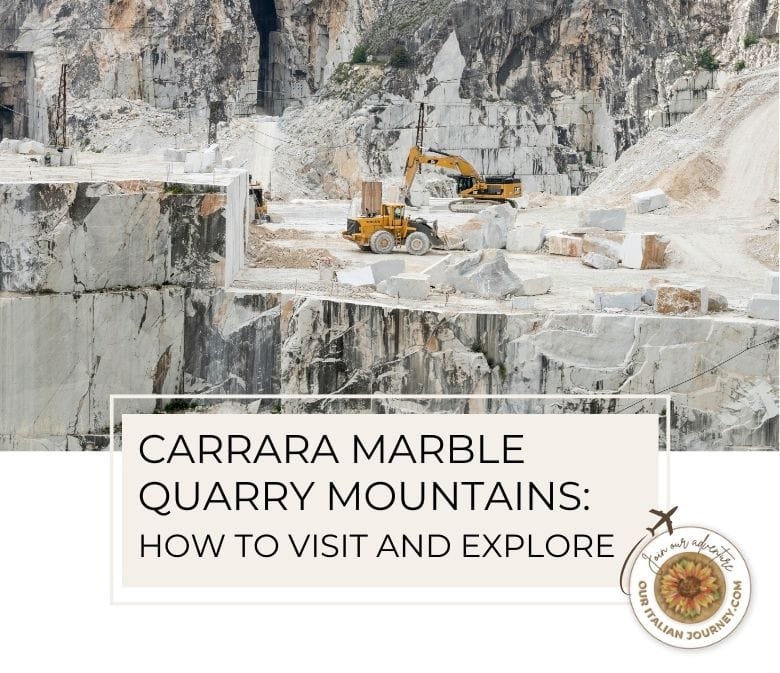
The Carrara marble mountains look calm and serene from afar—white peaks that seem to glow in the sunshine—that you almost think might be snow. But when you get there, though, it’s a totally different world. The roads get narrow. Suddenly, you’re inside a mountain, surrounded by walls cut smooth as glass.
We showed up expecting pretty views. What we found was something much bigger: a working landscape where ancient rock meets modern industry, and where the world’s demand for stone leaves visible marks on the land.
This post contains affiliate links that help keep this website running. By purchasing through our links, we make a small commission at no extra charge to you. Thank you for your support!
A Brief History of Carrara Marble
Carrara marble has been prized for over 2,000 years. The Romans called it “marmor lunense” and shipped it across the empire for temples, public buildings, and sculptures. Michelangelo chose it for some of his greatest works because it takes a high polish and holds fine detail. Even today, according to Wikipedia, more marble has been extracted from the quarries around Carrara than from anywhere else in the world.
For centuries, extraction was slow and dangerous, done with hand tools and sheer determination. Now, machines do most of the heavy work, but that historical legacy still hangs in the air.
How the Quarries Work Today
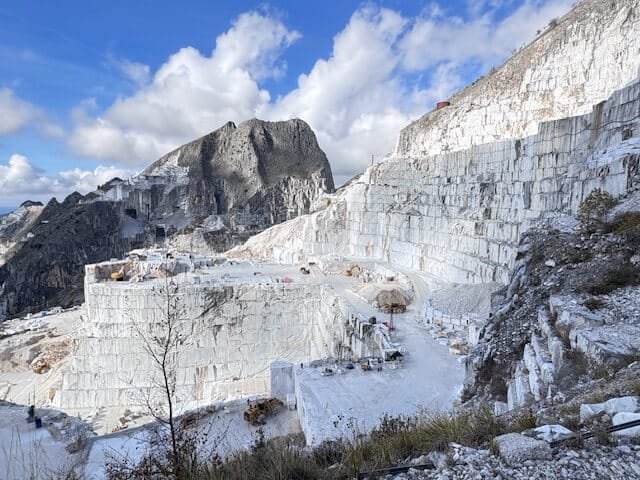
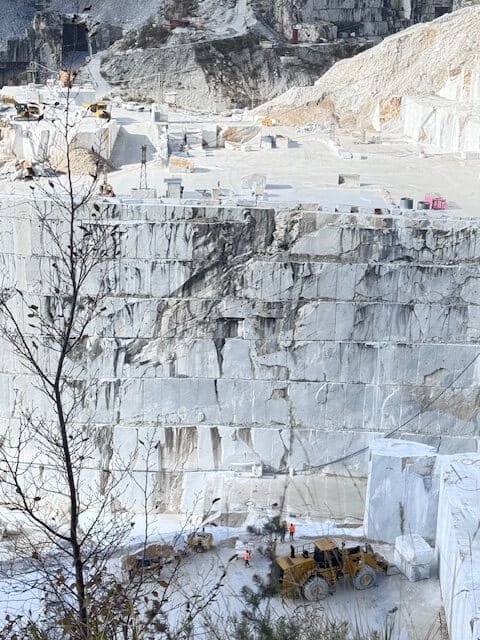
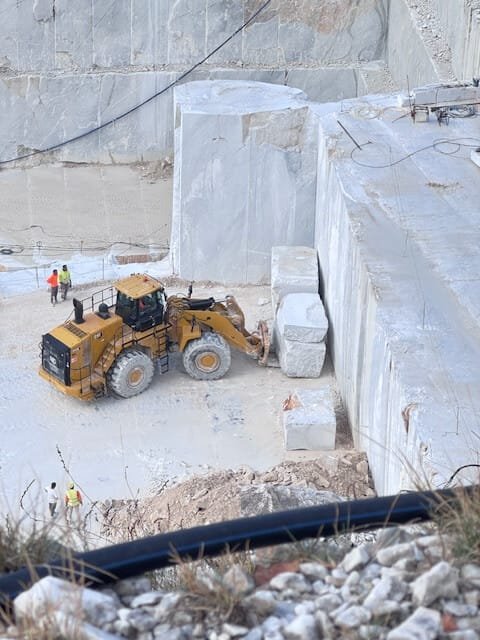
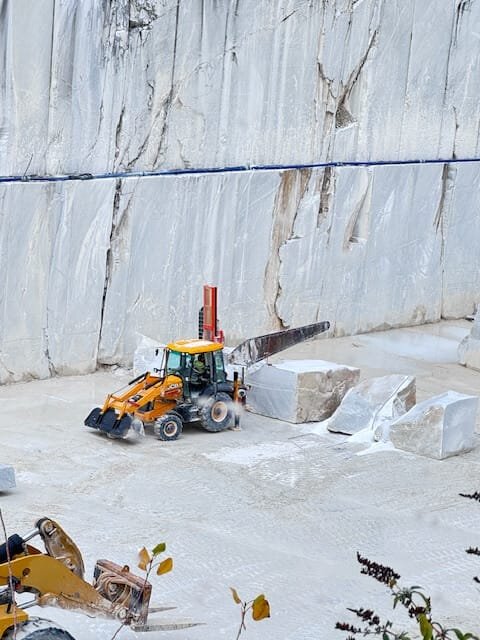
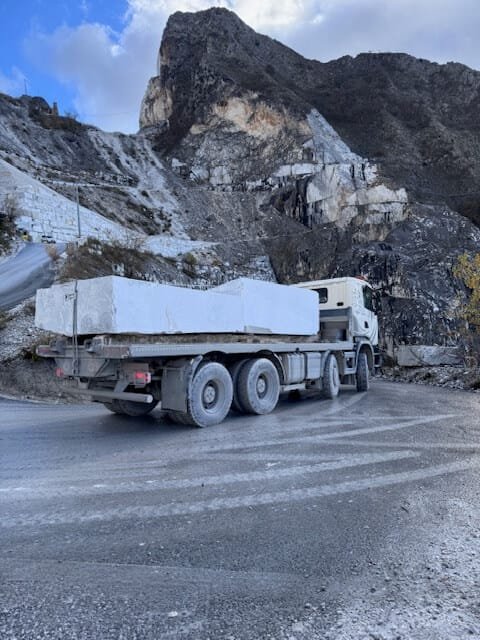
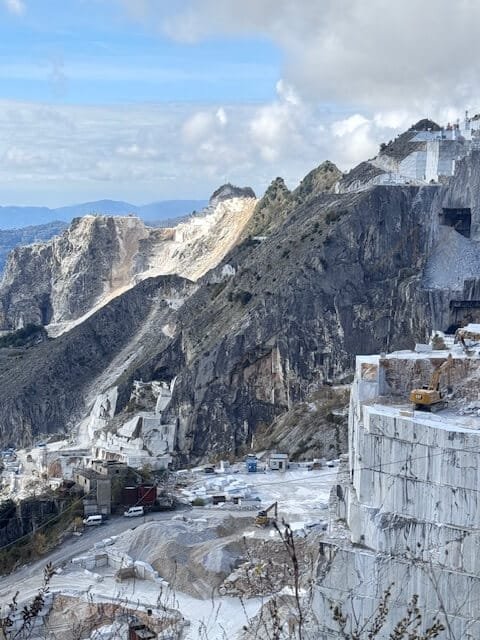
Carrara’s quarries aren’t a single place. There are dozens of sites scattered through the Apuan Alps—valleys of Torano, Miseglia, Bechsano, and Colonnata. Each produces marble with slightly different colors and veins. The easiest way to picture it: imagine giant steps cut into the mountainside. That’s a quarry. Huge blocks of stone are sliced out using long diamond wire saws and massive chainsaws that glide through rock like butter. Cranes lift the blocks onto trucks. These trucks then snake down twisting mountain roads toward sorting yards and factories.
Some of the marble is cut and polished right near the quarries. Most of it, though, is loaded onto trains or trucks headed to the port at Marina di Carrara. From the port, the massive blocks and finished slabs are shipped to destinations around the world.
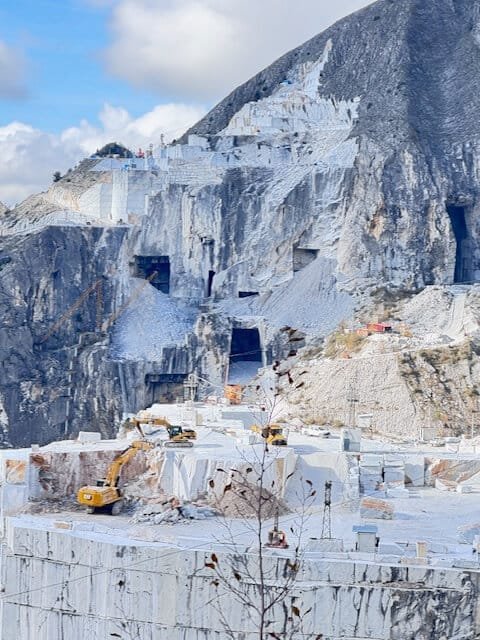
Inside bigger quarries, you’ll sometimes find tunnels carved into the mountain. Our tour guide pointed out all the different areas of the particular quarry we were standing in. He pointed out where the most recent white marble has been found. It’s a very special place, as you would imagine.
A little note about the small town of Colonnata. Colonnata, Italy, is famous for Lardo di Colonnata, a unique cured pork fat seasoned with herbs and salt, aged in marble basins, and served thinly sliced on toast.
How Much Marble Is Mined?
Numbers vary depending on the source, but what’s clear is that extraction today far exceeds anything from the past. More marble has been removed from Carrara in recent decades than in the previous 2,000 years combined. Annual extraction estimates reach around 4 million tons, dwarfing early 20th-century figures of a few hundred thousand tons per year.
A smaller estimate, focused on blocks for sculpture and ornamental work, puts production at around 200,000 tons annually, but that’s a more traditional count and doesn’t include all industrial uses or decorative stone. According to our tour guide, 30,000 tons are extracted from the quarry we were visiting each month.
Whatever number you use, the scale is striking. These mountains have been feeding global demand for marble for centuries.
Where Does The Marble Go?
- China is one of the biggest buyers of raw blocks — more than half of the specific export categories go there.
- United States is a top market for finished marble products, especially slabs, tiles, and custom architectural pieces.
- Middle East markets like the UAE and Saudi Arabia are growing fast, importing premium stone for luxury project.
- Europe also takes large volumes for everything from flooring to restoration work.
Globally, marble exports are part of a multibillion-euro market. According to a European source, Stonenews, in 2024Italy’s natural stone exports hit record highs, with processed stone (such as finished slabs and architectural pieces) leading the growth.
Inside the Industry
Carrara’s quarrying isn’t just about rock. It’s a business and a community. Hundreds of companies operate in the region, from huge international players to family-run workshops. Some quarries are owned directly, while others are leased. There’s even a centuries-old rule that says if you discover marble on land you control, you can open a quarry there—a tradition that still shapes ownership today.
While researching this post, I was surprised to discover that marble isn’t carved into statues anymore. Less than 1% of what’s extracted is used for classical sculpture; the rest goes into slabs, tiles, countertops, and industrial uses.
All Our Books
We are honored with receiving these “Top Pick” and “Recommended Read” Awards.

Visiting the Quarries Yourself
If you go, these are the things that really stick with you: the smell of stone dust, the mammoth scale of the cut faces, and the way sunlight makes the marble glow. It was cloudy the day of our tour, but the sun did come out briefly. And just at the right moment, when our guide was telling us about the solid white part of the mountain that was discovered… the sun appeared right on it. As if to point it out to us directly.
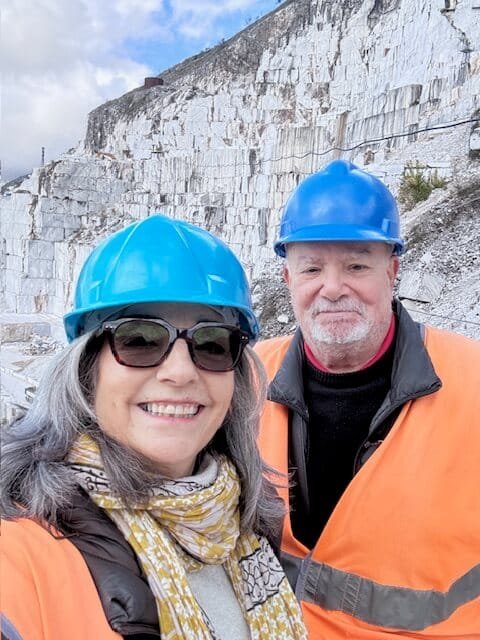
Quarry tours range from easy overlooks to deeper explorations in tunnels. Make sure to wear sturdy shoes, and bring a jacket (it’s cooler in the marble caverns). Our jeep tour was excellent, and the family that owns the company was terrific. We even stopped in their shop and purchased a mortar and pestle that the dad himself made from the marble from the quarry. I highly recommend Carrara Marble Tour Fantiscritti Quarries.
On a Personal Note
During our tour, our guide answered so many questions. He did point out how dangerous the job is—even today. He told us about how things used to be done and how safety is the most critical concern. I recall that when we all got out and were standing on the side of the road, a truck a bit further up the mountain was turned over. Our guide explained that the driver hit a loose patch, and the landslide pushed him down the hill. I was sad when I asked him later if the driver made it out alive. He said he didn’t.
In Conclusion
Standing in the heart of the Carrara marble mountains is one of those travel moments that stays with you. Even if you’re like us and live here permanently. You’re in a place that blends natural beauty, history, and global economics all at once. The stone you’re looking at might be under someone’s feet in New York, part of a skyscraper in Shanghai, or the centerpiece of a palace in Dubai.
And when you step back down at the bottom with dust on your shoes and a mountain of marble behind you, you realize you’ve experienced something rare — a working landscape that still writes world history in stone.






What a great post! Thanks for this. We have been a few times to the area and still have not done the Carrara Marble tour. It is definitely on the list for next time.
It took us so long to get there and I’m so glad we did. Unfortunately, since it was out of season, we didn’t go into a cave but as I always say… “Leave something to return to!”
I loved reading about this. I hope to see it in person one day soon.
Thanks so much, Diane! Please share our blog site with friends and family. We’re trying hard to get the word out. We’d love to meet you when you come to Tuscany! Keep us posted!