How to Play Scopa is something every Italy lover should learn before their next trip. Spend enough time in Italy, and sooner or later, you’ll notice a group of friends (mainly men) gathered around a table in a café under a tree with a deck of cards between them. The game is almost always Scopa, one of Italy’s oldest and most loved card games.
While it’s easy to learn, Scopa is much more than a way to pass the time. It’s a tradition that brings people together. Whether you’re sharing an afternoon with friends, escaping the summer heat indoors, or enjoying a holiday with family, you’ll find that this simple card game has been part of Italian life for generations.
This post contains affiliate links that help keep this website running. By purchasing through our links, we make a small commission at no extra charge to you. Thank you for your support!

The word Scopa means “broom” in Italian. The game gets its name from one of its most exciting plays—clearing every card from the table in a single move, or “sweeping” it clean.
A Brief History of Scopa
Scopa has been played in Italy since at least the 18th century, although historians believe similar games existed much earlier. Over time, it spread throughout the country, with different regions adding their own traditions and sometimes even their own scoring rules. Despite these small differences, the heart of the game has remained the same for centuries.
Today, Scopa is enjoyed by people of all ages. Grandparents teach it to grandchildren, friends play over an espresso at neighborhood cafés, and families often bring out a deck of cards after a meal. It requires very little equipment, is easy to learn, and offers just enough strategy to keep players coming back for “just one more game.”
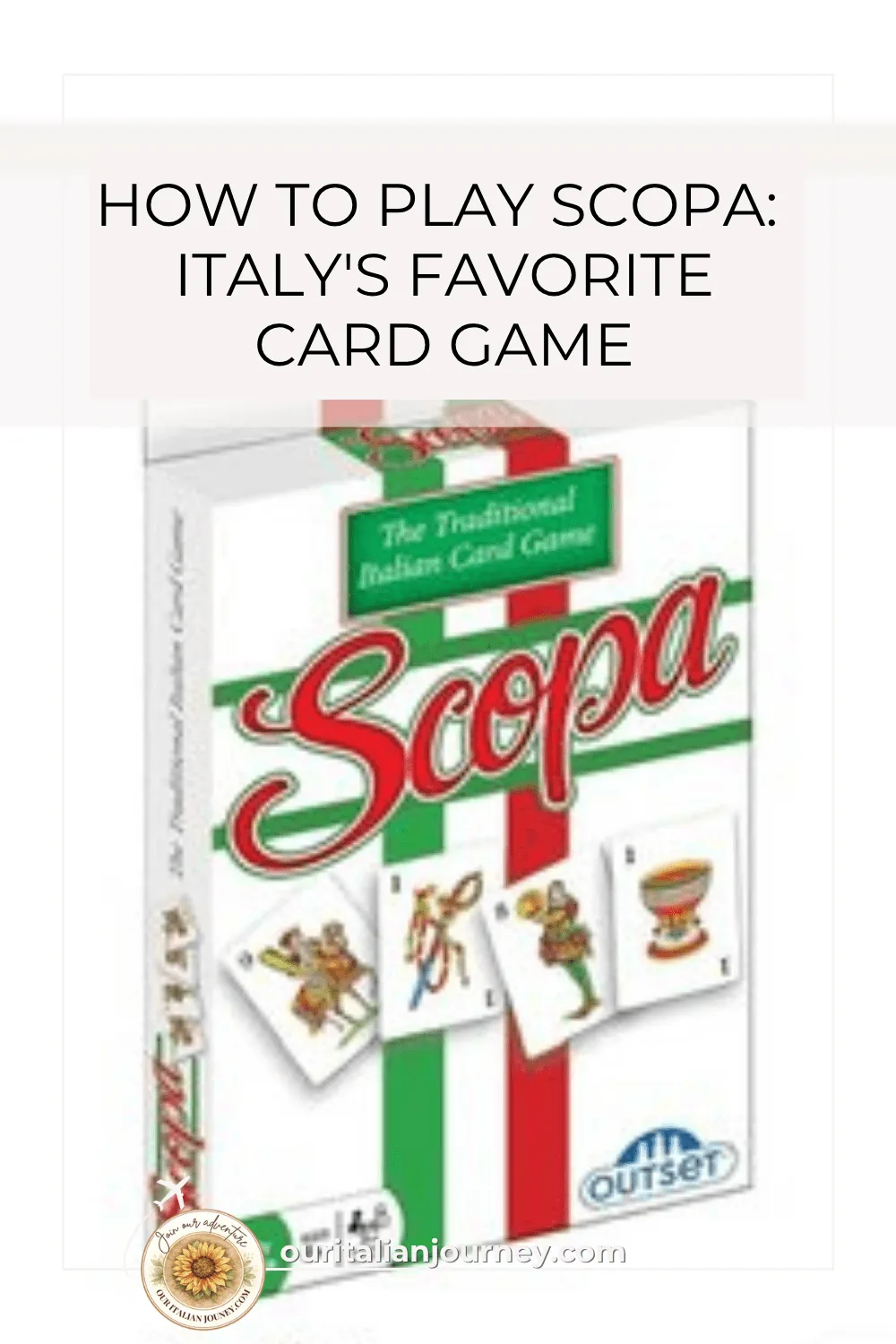
Here’s my link for the various Scopa decks we use. I suggest you start with this photo one first as it’s easier to understand.

One of the things we love most about Italy is how traditions like this continue to thrive. In a world filled with phones and tablets, it’s refreshing to see people laughing together over nothing more than a deck of cards.
What You’ll Need to Play the Game
One reason Scopa has remained so popular is because it’s wonderfully simple. All you need is a deck of cards, a few players, and a table.
To play, you’ll need:
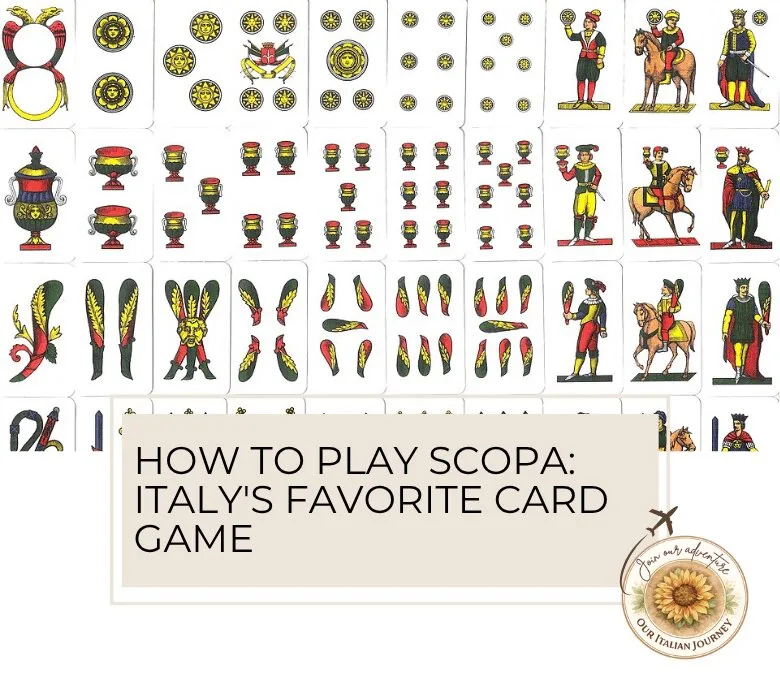
A traditional Italian deck has four suits:
- Denari (Coins)
- Coppe (Cups)
- Spade (Swords)
- Bastoni (Clubs)
Each suit contains ten cards:
- Ace
- Two through Seven
- Jack (Fante)
- Knight (Cavallo)
- King (Re)
Italian playing cards are sold almost everywhere in Italy. You’ll find them at tabacchi, stationery stores, supermarkets, and souvenir shops, making them inexpensive souvenirs you’ll actually use.
How Many People Can Play?
Scopa is most commonly played by two people, but it easily adapts to larger groups.
| Number of Players | How It’s Played |
|---|---|
| 2 | Classic game |
| 3 | Every player competes individually |
| 4 | Two teams of two |
| 6 | Two teams of three |
While four players can certainly enjoy Scopa, many Italians choose to play Scopone, a related game designed specifically for four players.
Setting Up the Game
Choose one player to be the dealer. The dealer gives three cards to each player before placing four cards face up in the center of the table. These four cards are the only cards that begin on the table.
The remaining deck stays face down. After every player has played all their three cards, the dealer hands out another three cards to each player. This continues until every card in the deck has been played.
Once the cards are dealt and everyone has picked up their hand, you’re ready to begin your first game of Scopa.
The Object of the Game
The object of Scopa is to capture cards from the table and earn points throughout each round. While collecting the most cards is important, it’s not the only way to score. Players also try to capture the valuable Sette Bello (the Seven of Coins = 1 point), collect the most Coins (Denari – each coin card = 1 point), build the strongest Primiera (= 1 point), and, whenever possible, make a Scopa by clearing every card from the table in a single move. A scopa equals 1 point to the individual or team.
Although the rules are easy to learn, winning requires strategy, observation, and a little planning. Paying attention to the cards your opponent collects can often make the difference between winning and losing.
How to Play Scopa
Now comes the fun part. Once everyone has three cards and the four starting cards are on the table, play begins with the player to the dealer’s right. Yes… for whatever reason, you are supposed to play counter-clockwise. From there, each player takes one turn at a time until all three cards have been played.
- On your turn, you have two choices. You can capture cards from the table (preferably) or play/discard a card to the table if you are unable to collect any cards.
- To capture cards, play a card from your hand that matches the value of a card already on the table. For example, if you play a 5 and there’s a 5 showing, you collect both cards and place them face down in your pile.
- You can also capture two or more cards whose combined value equals the card you’re playing. If you play a 7 and there’s a 4 and a 3 on the table, you may collect all three cards because they total seven.
** Important: There are a couple of important rules to remember. If there’s an exact match on the table, you must take that matching card instead of using a combination of other cards. If more than one combination equals your card, you may choose only one of those combinations.
- If none of your cards can make a capture, simply place one card face up on the table for the next player. Once everyone has played their three cards, the dealer gives each player three more until the deck has been used.
Although the rules are simple, Scopa is surprisingly strategic. Experienced players are always thinking a few moves ahead. They also pay close attention to which cards have already been played.
Let’s Continue With How to Play…
The most exciting moment in the game happens when you clear every card from the table in a single turn. This is called a Scopa, which means “broom” in Italian because you’ve “swept” the table clean.
Every Scopa earns an extra point at the end of the round, so players are always looking for opportunities to set one up. It’s often worth thinking ahead rather than making the first capture you see.
When you score a Scopa, many players leave one captured card face up in their pile as a reminder when it’s time to count the points. Gary usually just writes it on the scorecard when it happens. Either works.
Around an Italian card table, a well-timed Scopa usually earns smiles from one side and plenty of playful groans from the other!
Keeping Score
After every card in the deck has been played, any cards left on the table are collected by the player who made the final capture. The round is then scored.
Players earn one point for each of the following:
| Point | Awarded For |
|---|---|
| 1 | Capturing the most cards |
| 1 | Capturing the most Denari (Coins) |
| 1 | Winning the Primiera |
| 1 | Capturing the Sette Bello (Seven of Coins) |
| 1 | Each Scopa made during the round |
The Primiera is awarded to the player with the strongest set of cards, made up primarily of sevens. If there’s a tie, sixes are compared next, followed by aces, fives, fours, threes, twos, kings, knights, and finally jacks.
Some parts of Italy also award a point for the Re Bello (King of Coins). Like many Italian traditions, regional and family rules can vary, so don’t be surprised if your Italian friends insist their way is the “right” way! Just so you know, Gary and I play counting the Re Bello (King of Coins) as one point.
The game continues until one player or team reaches the agreed score, which is often 11 points in a two-player game. For 3 people, the total winning score is 16. For 4+ players, the winning score is the first to reach 21.
I’ve created a printable Scopa scorecard to make keeping track of points easy…
Helpful Italian Words
One of the best parts of learning Scopa is picking up a few Italian expressions along the way. Even if your Italian vocabulary is limited, these phrases are easy to remember and fun to use.
| Italian | English |
|---|---|
| A chi tocca? | Whose turn is it? |
| Tocca a me. | It’s my turn. |
| Tocca a te. | It’s your turn. |
| Scopa! | Scopa! (You’ve cleared the table.) |
How to Play Scopa: Tips For Your First Game
Like many classic games, Scopa becomes more enjoyable the more you play. While luck certainly plays a part, a little strategy goes a long way.
Here are a few beginner tips:
- Watch which cards your opponent collects.
- Protect the Sette Bello whenever possible.
- Think ahead instead of making the easiest capture.
- Remember that every Scopa is worth an extra point.
- Most of all, have fun and don’t worry if you lose your first few games.
Why Every Italy Lover Should Learn Scopa
One of the things we’ve learned after living in Italy is that the country’s greatest experiences aren’t always found in museums or famous landmarks. They’re often found in the simple moments—sharing a meal with friends, chatting in the piazza, or sitting around a table playing cards.
Scopa is part of that everyday life. It brings people together, sparks friendly competition, and creates plenty of laughter along the way. Learning the game won’t just give you another way to spend an evening. It will help you appreciate another small tradition that has connected Italian families and friends for generations.
The next time you see a group of Italians gathered around a deck of cards, you won’t have to wonder what’s happening. You’ll recognize the game, understand the excitement, and who knows—you might even be invited to sit down and play.
This video explains well, but at times, he uses a regular deck of cards, which, to me, is confusing. But the video, in general, is a good explanation that might help if you’re a visual learner (like me).
Buona fortuna, and may your next game include plenty of Scopas!
Love learning about everyday life in Italy? Be sure to subscribe to our newsletter for more Italian traditions, travel tips, and hidden gems from across Italy.